
Filicide Doesn't Pay...literally
The Haunted Garden: Folklore of the North African Imazighen People

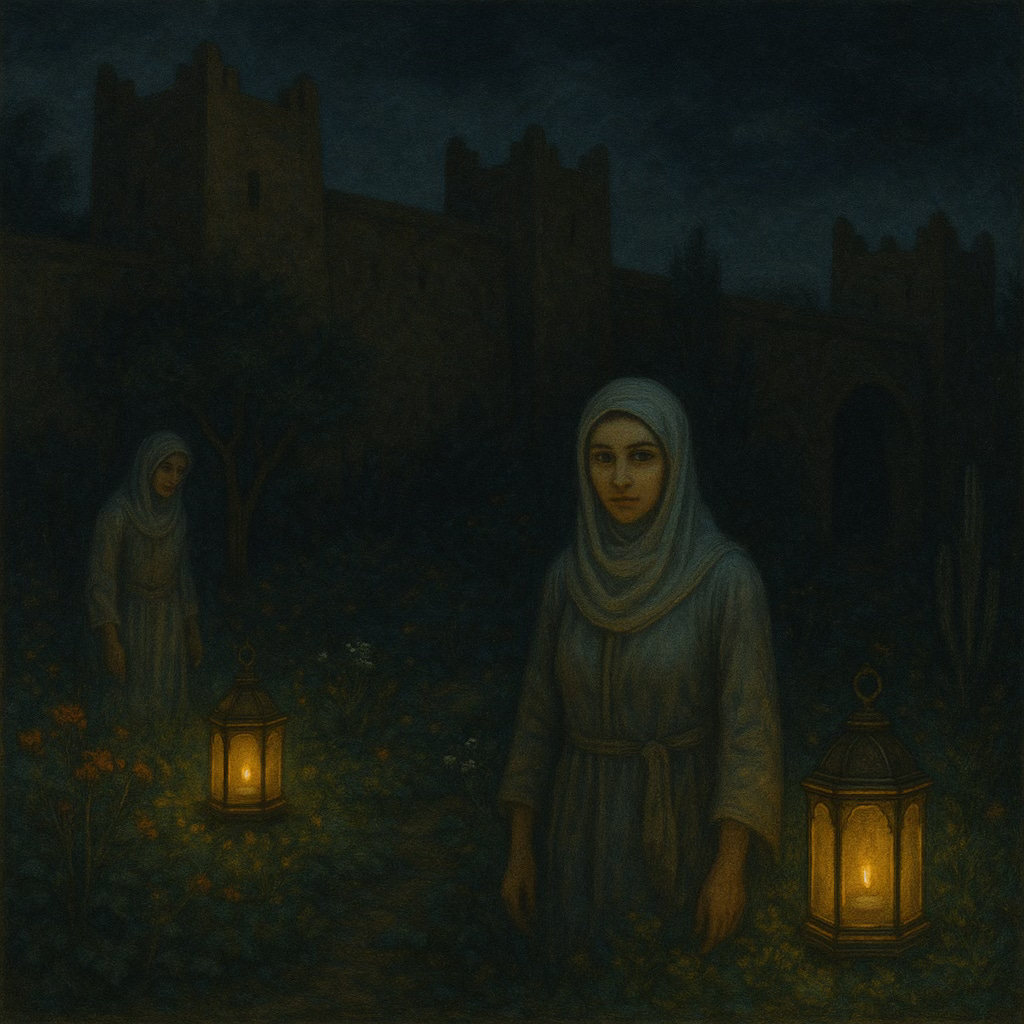
Morality tales; whether they be in folklore, fairy, mythological, religious, or modern history seem to center on or around women. They have the ability to be the ultimate patriarchal instruction guides. “Behave cautiously my dear girl. As your actions can and will have dire consequences!” That is, “if you disobey the rules hence laid down by your men!” Because these “rules” were clearly made only for her benefit and with her safety in mind (no ulterior motives). However, often these female protagonists of impropriety are either villain, victim or both. Regardless, “She knows of what she does!” Therefore, intention obviates sympathy.
In my first Storied Garden post, we’ll analyze and conjecture on the North African folktale of the Imazighen1 people called The Haunted Garden. It has the classic patriarchal plot. Women warned. Women disobey. Women become victims. But then it takes an interesting turn. It leaves one to wonder, for whom else is this morality tale really directed, and what is it trying to convey?
We’ll look at the story from a feminist point of view. I’ll also be dipping into a legal analysis (because unfortunately for you dear reader, once an attorney, always an attorney).
Read on, and tell me for whom the bell tolls for this folktale.
The Haunted Garden
There was a man who had a lot of money. He also had two daughters. The son of the king’s caliph and the other the son of the qadi, each asked for a daughter’s hand in marriage. But the father would not agree, despite his daughters’ desires.
The father had a garden near his home. At night his daughters would meet the sons and pass the time in conversation. One night the father happened to see them. The next morning he killed his daughters and buried them in that very garden. He then left on a pilgrimage.
Eventually one evening the sons went to a young man who knew how to play the flute and the rebab. They said to him “Come with us to the garden of the man who will not give us his daughters’ hands in marriage. You shall play for us on your instruments.” They all agreed to meet at the father’s garden that night.
When the time came, the musician went to the garden, but the two sons did not show up. The musician stayed and played his instruments anyway. Suddenly in the middle of the night, two lamps appeared. Under the lamps arose two girls from the ground. They said to the musician, ‘We are two sisters, daughters of the owner of the garden. Our father killed us and buried us here. You, you are our brother for this night. We will give you the money which our father has hidden in three pots. Dig here.” The musician obeyed, found the three pots, took them away, and became rich, while the two girls returned to their graves.2
What does this story tell us about these women’s lives?
They clearly live in a patriarchal society. So much so that there is no mention of their mother in this cautionary tale. We don’t know, what these unnamed women did to pass their days. But we can garner from the tenor of this tale that their days were probably not entirely their own. That’s because their father loomed large. So much so, that these women needed their father’s permission to marry. We can only imagine that this was ultimately their sole societal and familial purpose-marriage. It remained so across cultures and geography for women (and still for some) until the 1960s. But the tale tells us much more about this family dynamic. It tells us about the rules that governed the family structure…or THE rule. It was that their father’s decision was law. So much so, that their seemingly innocent rebellion (we can’t imagine any real impropriety going on under dad’s nose, can we?), of meeting with their beaus in the family garden was deadly! Dad was judge, jury and executioner, (minus the due process).
Unfortunately, this folktale isn’t far removed from what some women endure still to this day. Thankfully in most cultures the killing of children (aka: filicide and infanticide) is viewed as plain murder, but this hasn’t always been the case. Think about China’s female infanticide epidemic due to the country’s one child law and cultural preference of male children. And there are still countries, cultures, and tribes who would refer to the murder in our tale as justified, as a potential: “honor killing.”
According to the Oxford Handbook of Gender, Sex and Crime: Honor killings are an extreme type of gendered domestic violence, with peculiar characteristics related to the social and cultural traditions of tribal, patriarchal societies. The killings are motivated by the goal to restore a family’s collective reputation that has been damaged by the victim’s violation of very strict norms regulating female sexuality, and they are viewed by the assailants as a legitimate punishment, often condoned by local communities and tolerated by state agencies. While the paradigmatic honor killing is the murder of a young woman by her male relatives, intimate-partner homicides are often included in definitions of the crime, as are cases with male victims.3
A report issued by the United Nations Population Fund regarding Turkish honor killings, reinforces the sexuality component stated above. A woman’s honor is primarily tied to her sexuality. There is a direct need to control it.4 In just as direct but seemingly less brutalistic format, honor killings seem closely related to the illegality of abortion. Whether it’s our folktale or the current reality of the overturn of Roe v. Wade in the U.S., or the continued prohibition of abortion else where around the world- the sexual decisions of women are not their own still. If you make the wrong one, it can end in death.
Courageous or Careless?
Try being a woman in a society or household where men dictate your past, present and future. You’d feel controlled and trapped. What is the very human response to those feelings? Rebellion! No matter what form defiant acts take, they are in essence the contravention of rules. However, there is a fine line between courageous and careless that’s not always easily discernible. If you’re young, a lot of rebellious decisions take a large leap into the careless side. But, we don’t know the age of these women victims. It would not be wildly off base to assume they're young (teens or very early 20s), because historically women were expected to marry young and have babies. Even so, if you’re like me when reading this story, you couldn’t help thinking “Why did you have to rendezvous in the family garden!?” Well…there may be an explanation for this.
The reason could have be purely geographical. The Imazighen, for centuries, have primarily inhabited mountainous, rural, and desert regions across North Africa, including Morocco, Algeria, and Libya. It’s possible that there was no where to rendezvous. Their family could have lived outside the main confines of the tribe, or the tribe itself was sprawled. But I’m willing to wager there’s an easier answer. They couldn’t risk being seen. By anyone! If you know dad’s a heavy sleeper, it couldn’t be easier. Until it isn’t.
A Legal Perspective
It’s my fifth favorite subject next to gardening and horticulture; history; mysteries; and books. In my former life, I was a family law litigator with my share of companion criminal cases for a large portion of my public clients (and I handled the one-off private felony case or two). In a western culture and court system, there is no excuse for a double murder. Cultural tradition will not mitigate the deed. The only question to be argued outside of, “Did the person accused commit the crime?” is the level of intentionality attributed to the murderer. On opposite spectrums of the law is premeditation and then there is accident (and within that is self-defense and insanity which is a very difficult burden of proof the defendant carries). In this folktale the only thing a prosecutor would seek to prove is the level of intentionality attributable to the father (without diminished capacity, i.e. insanity). This is the angle from which I’ll assess the legalities of this folktale.
What initially stuck me at the first reading, is why dad felt the need to kill his daughters? Why did the sons of the king’s caliph and qadi (the boyfriends of our victims) never seemingly notified the authorities? Any time you build a case, you must understand and know the undisputable and disputable facts (the latter of which all litigated cases hinge), and the context and nuances that govern them. To understand all our men’s actions and motives, we first need to understand the work of the boyfriends’ fathers.
One of the boyfriend’s father was the king’s caliph. A Caliph is the chief Muslim civil and religious ruler of a community, and regarded as the successor of Mohammed himself, (who is believed to be the messenger of God and is the promulgator of the Islamic religion).5 The other boyfriend’s father was the King’s Qadi: a Muslim judge who renders decisions according to the Sharīʿah (Islamic law). The qadi’s jurisdiction theoretically includes civil as well as criminal matters. It is believed it was not until the second caliph under Umar I, that the title and work of a qadi came into existence in order to eliminate the necessity of Umar I himself personally judging every dispute that arose in the community.6 Interestingly enough, our female victims’ father was opposed to his daughters marrying into (what can only be assumed to be) two highly influential and powerful families within their community and in the context of the Islamic religion as a whole. It could relate to the necessity of providing a dowry for their union. Regardless, seemingly the benefits would outweigh the cost. Even more baffling is the fact that instead of the two boyfriends seemingly voicing their concerns about their girlfriends to their fathers, whom for all intents and purposes are the authorities of the community, they instead opt to go to the local musician.
It’s difficult to ascertain whether the two men knew of their girlfriends’ demise. Why does it matter? Aiding and abetting a murder or murderer is a criminal offense. It matters in terms of building a case against the boyfriends, and understanding time. Meaning, how much time has dad been on the run and have these boyfriends intentionally aided his getaway by opting to get the assistance of the local musician.
Music has a deep cultural context for the Imazighen people, and the referred to instruments in particular in our tale, the flute-called a ajouag; and the rebab. The Ajouag is traditionally made of reed or wood. It is a straight, long, wooden tube, often with a conical shape, similar to a trumpet. It is used by Imazighen shepherds, especially in rural mountainous areas (this also gives us a clue as to where our folktale may have taken place). It’s believed among other things that the ajouag’s music connects the soul with the earth, sky, and ancestral spirits. The rebab is a three stringed instrument with a long neck and oblong rounded body, played with a horse-hair bow. However, its use is not isolated to the Imazighen people, unlike the ajouag. The rebab is associated with spiritual lamentation among other things.
The boyfriends’ request of this musician’s use of these specific instruments could lead an attorney down the path of arguing that the boyfriends knew of their girlfriends’ deaths. Given the women’s father’s opposition to marriage, it’s highly unlikely a sweet toon would bring him around, especially if the boyfriends’ family’s societal rank could not. However, without a lot more evidence, you can’t determine for sure if the boyfriends knew of their girlfriends’ deaths and then intentionally aided, by omission, the father’s flight.
What we do know is that we would have a great circumstantial case against the victims’ father (outside of the fact the folktale tells us he killed and buried his daughters’ bodies in the garden), because most of the important factors of a criminal case are met.
He had the means. We don’t know what tool or method he used. But he was probably larger in stature than them. You learn in criminal law that most seemingly mundane household objects can be used as weapons with the right force and accompanying circumstances. But any prosecutor worth their salt will want to find the murder weapon.
He had the motive. His daughters defied him, by meeting with the boyfriends of which he did not approve. That made him angry enough to kill them.
He had the opportunity. They were living in his house. Don’t forget he took a “pilgrimage” the day after he buried his daughters. Flight can be used against you, at a trial. Especially a trip so close in time after a murder.
What we’ll never know exactly how much planning went into his daughters’ deaths. But it’s arguable there was sufficient enough time to plan. He caught his daughters the night before in the garden with their boyfriends. He killed the women the next morning. Therefore, he had all night to plan for this eventuality. How he would kill them. Where he would bury them. And where he would go on his pilgrimage, and what he would take. As with all cases, prosecutors charge based on what they believe they can prove. Despite not knowing more, I believe a First Degree Murder charge (meaning the murder was premeditated) would not be out of the question for a prosecutor.
One question remains, “Why bury the bodies in the garden.” The simple prosecutorial answer is, convenience. Plus, who has more control over the garden than dad-who goes in and out of it and determines what’s planted in it. He’d have constant control over the burial site. A more disturbing answer would be the symbolism of it. The women were buried where they dared to defy him, thus forever reaping the consequences of their actions there. A more humanly complex answer could be the beauty and importance of the garden.
What’s the Relevance of the Garden?
Many Imazighen are known as subsistence farmers, with small holdings of goats, sheep, fruits, nuts and vegetables often grown or cared for in walled gardens (known as "riads") or grazing land (both of which can be referred to as “agdal”) adjacent to their adobe homes-particularly in mountain regions.7 It’s believed by scholars that:
“owing to the harsh climate in most of the Muslim countries and to a great moral emphasis on family privacy, the enclosed garden became a typical component for even the simplest house in the Middle East.”8
From a larger Islamic cultural perspective, gardens are introspective, spiritual places. The emphasis is on privacy, whereas in Western cultures a garden’s emphasis is about display. There are “164 verses scattered through four chapters” in the Qur'an describing “the colors, sounds, smells, spatial elements, microclimates, trees, flowers, and waters of Heaven.”9
It is quite possible that dad’s burial of his daughters in the garden was actually a fitting spiritual resting place for them (outside a traditional burial), and place he could spend his time in deeper spiritual contemplation and discussion with them. Unfortunately, there is an offset of this notion. Clearly, dad thought the garden was important, but for possibly more greedy and capitalistic reasons. This is where he buried his money. This is also where he lost this important item, by the hand of his daughters’ spirits.
For whom is this Cautionary Tale Directed?
The Haunted Garden has all the trappings of a patriarchal warning to women. But then the end of the folktale flips the latter on its head. The daughters get their revenge by giving away, to the musician, something clearly dear to their father. The buried money.
So is this a cautionary tale for women or domineering male heads of household? The consensus is that Amazigh culture has and continues to be patriarchal. However, of the approximately one-hundred tribes, the Tuareg tribe have a matrilineal system of inheritance which some argue as proof of a matriarchal sub-culture. But it’s commonly agreed that it’s simply a female preferred system that still lives within the other rules of patriarchy.
Garden detectives, what do you think? Who should heed the warning of this folktale? What else does this story tell us about these women’s lives, and what other evidence do you see that a prosecutor could rely on that wasn’t mentioned? Put all your skill and opinions in the comments.
See you on the next garden related case!! -Danielle
Want More?
To hear a sample of Amazigh music, specifically from The Kabyles of Algeria go here to Smithsonian Folkways Recordings to hear sample songs with the ajouag (or Shepard’s flute) included.
FOR PAID SUBSCRIBERS: Listen to the audio of me in my garden trying to bury a body (not literally), as discussed in the folktale. It’s not as easy as you think.
Imazighen is the plural of Amazigh. Also called the “Berbers” people, a pejorative term that has stuck since the Roman invasion of North African derived from the Latin for “Barbarians.”
See, African Folk & Fairytales, editor Jackson J.K., Flame Tree Publishing, 2022, pgs. 210-211.
See, Oberwittler, Dietrich and Kasselt, Julia, 'Honor Killings', in Rosemary Gartner, and Bill McCarthy (eds), The Oxford Handbook of Gender, Sex, and Crime (2014; online edn, Oxford Academic, 1 July 2014), https://doi.org/10.1093/oxfordhb/9780199838707.013.0033, accessed 15 Apr. 2025.
We can date our cautionary folktale potentially as far back as 634 (but no earlier) when Umar I became the second caliph.
See, Berber Culture in Morocco, https://www.responsiblevacation.com/vacations/morocco-cultural/travel-guide/berber-culture-in-morocco#:~:text=The%20Amazaigh%20people%20can%20be,artisan%20work%20such%20as%20weaving; see also, The Moroccan Tradition of the Moorish Garden, https://www.bbc.co.uk/travel/article/20100720-the-moroccan-tradition-of-the-moorish-garden-#:~:text=Gardens%20have%20great%20importance%20in%20Morocco%2C%20as,provide%20calm%2C%20shade%2C%20perfume%2C%20beauty%20and%20pleasure.
See, Hamed, S. El-D. Paradise on Earth: Historical Gardens of the Arid Middle East, Arid Lands Newsletter, No. 36, Fall/Winter 1994. (https://cales.arizona.edu/OALS/ALN/aln36/Hamed.html). This is a very interesting article and should not be missed if you are a garden aficionado.
See Id.